

How to Choose Coffee Flavor Profiles That You'll Love
Last Updated: October 31, 2026
Quick Summary
To choose coffee flavor profiles you'll love, start with your taste preferences instead of the bag label: if you add milk and sugar, look for chocolate, caramel, and nutty notes, while black-coffee drinkers should lean toward fruity, floral, or citrus-forward coffees. Every cup sits on four scales, acidity, sweetness, bitterness, and body, and balance matters most.
- Coffee flavor profiles are built from aroma, acidity, sweetness, body, and finish.
- A tasting note is a comparison, not an ingredient, so blueberry means shared aromatic compounds.
- Slurp rather than sip, and let coffee cool a few minutes so flavors open up.
- Light roasts keep origin character, medium roasts balance, and dark roasts turn smoky and bold.
- Store beans in an airtight, opaque container at room temperature and skip the fridge.
Table of Contents
- Start With Your Taste Preferences, Not the Label
- Coffee Tasting Notes for Beginners: Build Your Sensory Vocabulary
- Use a Coffee Flavor Wheel to Narrow Your Choices
- How Coffee Roast Levels and Flavor Connect
- How to Store Freshly Roasted Coffee Beans for Consistent Flavor
- Pick Your First Bag From Beans & Rice
- Frequently Asked Questions
Start With Your Taste Preferences, Not the Label
Most people learn how to choose coffee flavor profiles by reading bags, then guessing. That's backwards. Customers often find coffee easier to enjoy once they name what they actually like.
The simple truth: coffee flavor profiles are the total taste impression of a cup, built from aroma, acidity, sweetness, body, and finish. You don't need a trained palate, just a starting point.
Ask yourself three questions before you buy anything:
- Do you add milk and sugar? Then look for chocolate, caramel, and nutty notes.
- Do you drink it black? Lean toward fruity, floral, or citrus-forward coffees.
- Do you want bold or gentle? That points you to dark or medium roasts.
The four taste dimensions in every cup
Every coffee sits somewhere on four scales. These four words give you a shared language with any roaster:
- Acidity: the bright, tangy snap on your tongue. Think green apple or lemon. It is not the same as sour.
- Sweetness: the natural sugar feel, like caramel or honey. Good coffee is sweet without added sugar.
- Bitterness: the deep, dry taste. A little adds structure. Too much tastes burnt or harsh.
- Body: the weight on your tongue, from thin and tea-like to thick and syrupy.
Balance is the fifth word, and it matters most. A balanced cup has no single dimension shouting over the others.
Coffee Tasting Notes for Beginners: Build Your Sensory Vocabulary
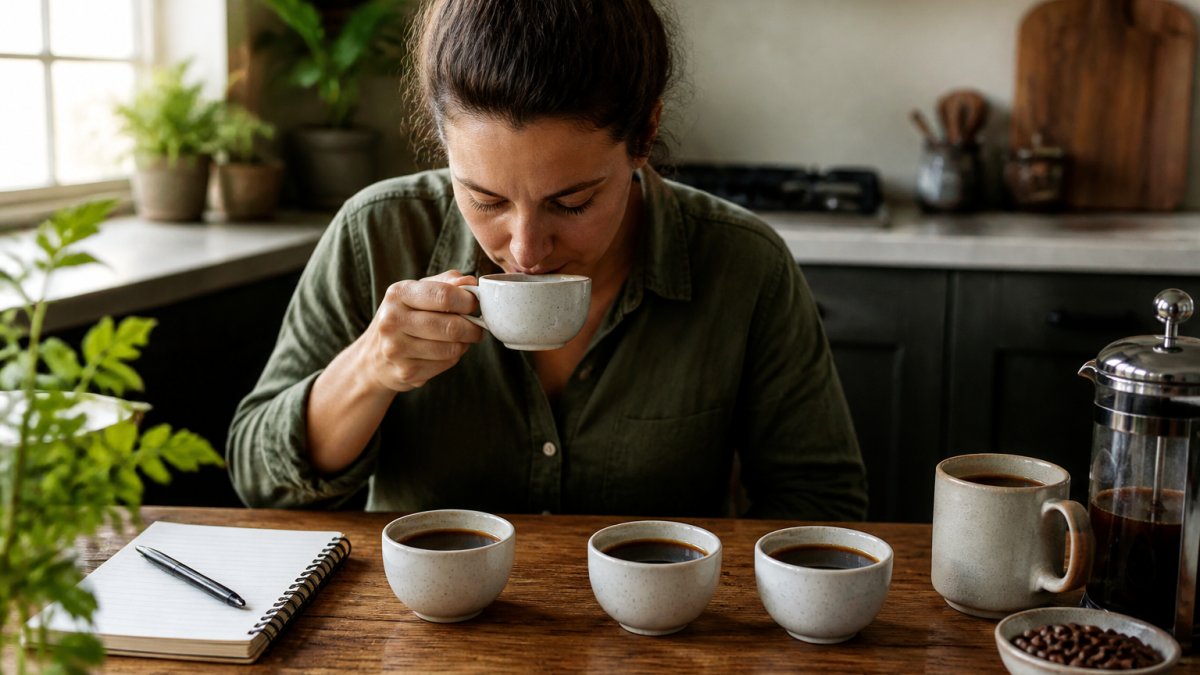
Coffee tasting notes for beginners are simpler than they sound: they are just words for what you already smell and taste. You need repetition, a few sensory prompts, and a notebook.
First, calibrate what a tasting note actually means
A tasting note is a comparison, not an ingredient. When a bag says "blueberry," it means the coffee shares aromatic compounds with blueberries, not that any were added.
A quick calibration exercise: smell a real lemon peel, then dark chocolate, then a strawberry. Notice how each hits your nose differently. Now smell your coffee and ask which is closest, not a match, only the nearest neighbor.
A repeatable ten-minute tasting method
Use the same routine every time so your notes are comparable:
- Smell the dry grounds first. Write down the first three words that come to mind. Do not edit yourself.
- Smell the brewed cup once it cools slightly. Hot coffee hides aroma; most of what you call "flavor" is actually smell.
- Slurp, don't sip. A loud slurp spreads coffee across your tongue and pushes aroma into your nose.
- Wait, then notice the finish. The taste that lingers is often the clearest note. Count to ten and write what remains.
- Compare two cups side by side. Contrast teaches faster than any guide.
A common mistake is tasting coffee too hot. Let it cool a few minutes. Flavors open up as the cup drops toward room temperature, and the difference between a "boring" cup and a "sweet" one is often just five degrees.
Sensory prompts to get past "it tastes like coffee"
When you are stuck, run through these prompt pairs and pick the closer one:
- Fruit: Is it more like citrus (lemon, orange) or stone fruit (peach, cherry)?
- Sweetness: Is it more like caramel, honey, or brown sugar?
- Roast: Is it more like toast, chocolate, or smoke?
Write one word per prompt. Five words is a complete tasting note for a beginner.
A simple scoring sheet
Score each cup from 1 to 5 on five lines. This turns vague impressions into a record you can compare across bags:
Line |
1 (low) |
5 (high) |
|---|---|---|
Acidity |
Flat |
Bright, lively |
Sweetness |
None |
Honeyed, clear |
Bitterness |
Harsh |
Pleasant structure |
Body |
Thin |
Syrupy |
Balance |
One note shouts |
Nothing shouts |
Keep the sheet with the bag name and roast date. After five bags you will see your own pattern, and that pattern is your buying filter.
Keep your words plain. "Tastes like toast" is a real note. So is "smells like a lemon peel." The Specialty Coffee Association's flavor resources exist to give you shared vocabulary, not to make tasting feel like an exam.
Use a Coffee Flavor Wheel to Narrow Your Choices
A coffee flavor wheel is a circular chart that groups tastes into families: fruity, floral, sweet, nutty, spicy, and roasted.
It works like a map. Say a coffee tastes "fruity." Move out one ring to "berry," one more to "blueberry." Now you have a word to search for on a bag.
Use the wheel in two directions:
- From cup to word: taste a coffee, then find the closest word on the wheel.
- From word to cup: pick a word you love, then look for coffees that list it.
Most guides skip the second direction, and that's the one that saves you money. It turns a vague craving into a shopping list.
How Coffee Roast Levels and Flavor Connect
Coffee roast levels and flavor are tied together tightly. The roast decides how much of the bean's origin character survives the fire.
Green coffee holds sugars and amino acids. As bean temperature climbs, Maillard reactions and caramelization build the brown, toasty, sweet notes we associate with coffee. Push further and pyrolysis creates smoky, bitter, charcoal-like flavors. The longer and hotter the roast, the more the roast's own flavors take over from the bean's origin flavors.
- Light roast: dropped early, so origin character survives. Expect higher acidity, more fruit and floral notes, lighter body, and sometimes a tea-like finish. Less forgiving to brew, under-extraction turns them sour and grassy.
- Medium roast: the middle ground most drinkers prefer. Acidity and sweetness balance, chocolate and caramel notes appear, and body fills out. Easiest to brew consistently and the most milk-friendly.
- Dark roast: roasted long enough for pyrolysis to dominate. Body and bitterness rise, acidity drops, and smoky, bittersweet, sometimes ashy notes appear. Forgiving to brew and holds up in espresso and milk drinks, but buries delicate origin notes.
Light, medium, and dark roast side by side
Roast level |
Taste |
Acidity |
Body |
Best for |
|---|---|---|---|---|
Light |
Fruity, floral, bright |
High |
Light |
Black coffee drinkers who want origin character |
Medium |
Chocolate, caramel, balanced |
Medium |
Medium |
Most drinkers, milk-friendly, easy to brew |
Dark |
Smoky, bold, bittersweet |
Low |
Heavy |
Espresso, milk drinks, forgiving brewing |
Use roast level as a buying filter
Roast level is the fastest filter you can apply in a shop or on a bag, because it tells you what the cup will emphasize before you ever brew it:
- If you add milk and sugar, start at medium or medium-dark. The chocolate and caramel notes survive milk; delicate fruit does not.
- If you drink black and want to taste the farm, start at light to medium-light.
- If you want a bold, low-acidity cup for espresso, start at medium-dark to dark.
Many drinkers who think they dislike "acidic" coffee actually dislike under-extracted light roasts. Before writing off light roast, try one brewed slightly finer and a touch cooler; the brightness often softens into sweetness.
If you want to see the light end in person, our Blonde roast shows what a gentler roast tastes like. For the bold end, Italian Roast 1 is the deep, dark counterpart.
How to Store Freshly Roasted Coffee Beans for Consistent Flavor
How to store freshly roasted coffee beans decides whether tomorrow's cup tastes like today's.
Oxygen, light, heat, and moisture are the four enemies. Keep beans in an airtight, opaque container at room temperature. Skip the fridge: it adds moisture and pulls in food smells. Skip the freezer unless storing a sealed bag long-term.
Buy in amounts you'll finish within a few weeks. Whole beans stay fresh longer than ground coffee. Grind right before brewing.
Brewing variables that change what you taste
The same beans can taste sweet one morning and harsh the next. Brewing changes the cup as much as the roast does.
- Grind size: too fine and the cup turns bitter; too coarse and it tastes weak and sour.
- Water temperature: water that's too hot pulls out harsh compounds. Let it cool slightly off the boil.
- Brew time: longer contact means more extraction, up to a point.
Change one variable at a time. If a coffee tastes sour, grind finer or brew longer. If it tastes bitter, do the opposite. That habit fixes most "bad" cups.
Pick Your First Bag From Beans & Rice
Ready to put this into practice? Start with one bag and one clear preference, not five bags and hope.
If you like chocolate and a little fruit, our Mexico single origin brings chocolate, cinnamon, and green apple in a medium roast. Prefer something smooth and rounded? Fairtrade® Guatemala sits at medium-light. Want bold and heavy? Fairtrade® Sumatra runs medium-dark.
Browse the full coffee collection, or jump straight to blends if you'd rather have an easy all-rounder than a single farm's character.
Frequently Asked Questions
How do I choose a coffee flavor profile if I don't know what I like yet?
Start by thinking about flavors you already enjoy outside of coffee. If you like dark chocolate and caramel, try a medium or dark roast with those notes. If you prefer fruit or tea, a light roast with citrus or berry notes may suit you better. Order small amounts of two or three different roasts, taste them side by side, and note which one you reach for again. Beans & Rice offers single-origin options like Mexico with chocolate, cinnamon, and green apple notes to help you compare.
What are the main coffee flavor profiles?
Most coffee flavors fall into a few broad families: fruity (citrus, berry, apple), floral, chocolatey, caramel or brown sugar, nutty, and spicy. These come from the bean's origin, variety, processing method, and roast level. A coffee flavor wheel organizes these families so you can describe what you taste and compare bags more easily. For example, a washed Mexican coffee often shows chocolate and apple,
Does roast level really change how a coffee tastes?
Yes. Roast level affects acidity, sweetness, body, and bitterness. Light roasts keep more of the bean's origin character, so you taste fruit, floral notes, and brighter acidity. Medium roasts balance acidity and sweetness with chocolate and caramel notes. Dark roasts push origin flavors into the background and bring forward smoky, bitter, and bold flavors. If you want to taste a coffee's growing region, choose a light or medium roast.
How should I store freshly roasted coffee beans to keep the flavor?
Keep beans whole and store them in an airtight container away from light, heat, and moisture. A cool cupboard works better than a fridge, which introduces condensation. Buy amounts you will finish within two to four weeks of the roast date. Grind just before brewing, because ground coffee loses its aroma and flavor notes within days.
Choosing a coffee you love comes down to naming what you taste, matching it to a roast, and storing it well. That's a skill anyone can build in a few cups. At Beans & Rice, we roast specialty-grade coffee from sustainable farms and ship it the same day it's roasted, with flavor profiles ranging from bright single origins to smooth flavored roasts. Every bag you buy helps feed children through our KidsServe mission. Get started with Beans & Rice and find the cup that fits your taste.
